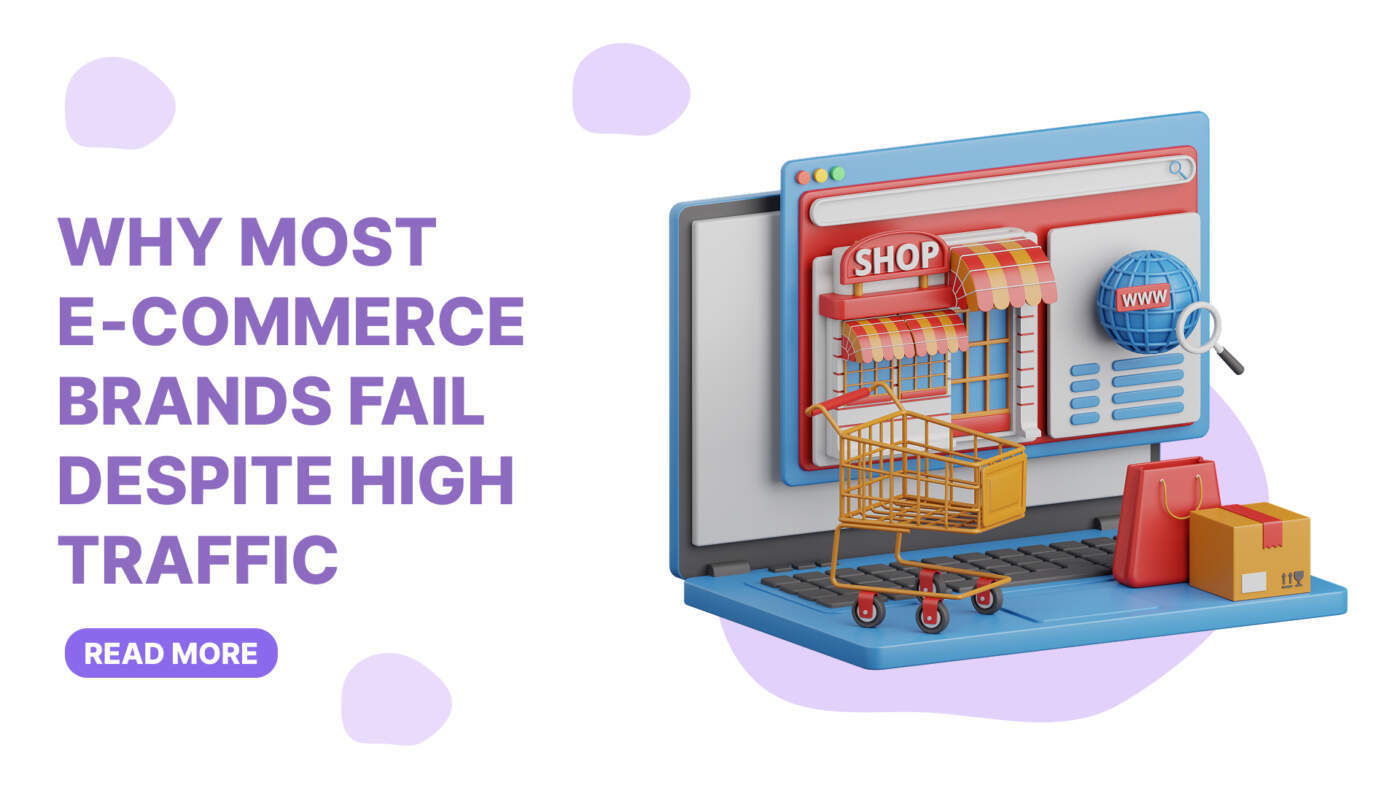

High traffic feels good—but in e‑commerce, it often hides why e‑commerce ROI is actually declining. Many e‑commerce brands confuse traffic with progress, even when revenue tells a different story.
Dashboards spike. Ad accounts look busy. Screenshots get shared. And for a moment, it feels like the business is finally “working.”
But then reality shows up.
Revenue doesn’t move the way it should. Margins tighten. Growth feels harder, not easier. And suddenly the question becomes uncomfortable:
If we have all this traffic… why isn’t the business growing?
The answer is simple, but not easy to accept:
Traffic is not growth. And in many cases, it’s hiding the real problems.
This is why so many e‑commerce brands fail despite high traffic—and what actually needs to change.

The E‑Commerce Traffic Trap: Why Traffic ≠ Revenue
Traffic is one of the most misleading metrics in e‑commerce.
It’s visible. It’s easy to track. And it gives the illusion of momentum. But traffic alone says nothing about whether your business is healthy.
You can double your sessions and still:
- Lose money on every order
- Struggle to convert visitors into buyers
- Depend entirely on paid ads to survive
When teams celebrate traffic without tying it directly to revenue, they start optimizing for activity instead of outcomes.
That’s where the traffic vs revenue problem begins.
Problem #1: You’re Attracting the Wrong E‑Commerce Traffic
Not all traffic is valuable.
Many brands scale by widening their targeting, chasing broader keywords, or leaning heavily into awareness campaigns. Traffic goes up—but intent goes down.
You end up attracting people who are:
- Just browsing
- Comparing prices with no loyalty
- Curious but not committed
- A poor fit for what you actually sell
More traffic doesn’t fix this.
It makes it worse.
Low‑intent traffic overwhelms your site, drags down conversion rates, and destroys ecommerce ROI. The problem isn’t visibility—it’s relevance.
Strong brands don’t ask, “How do we get more people here?” They ask, “Why are the right people coming here?”
Problem #2: E‑Commerce Conversion Is Treated Like a Side Project
Most e‑commerce brands say conversion matters.
Few actually build for it.
Instead, conversion optimization becomes a series of small, disconnected actions:
- Tweak a headline
- Change a button color
- Add a badge or popup
These things aren’t useless—but they’re not a system.
Real conversion happens when everything works together:
- The message in the ad matches the product page
- The value is immediately clear
- Objections are handled before they arise
- The buying decision feels safe and simple
When traffic increases but this system doesn’t exist, revenue stalls. No amount of visitors can compensate for unclear positioning and weak persuasion.
Problem #3: Poor E‑Commerce ROI Due to First‑Purchase Dependence
Even when traffic converts, many brands are still leaking revenue.
Why?
Because the business is built almost entirely around first‑order sales.
Common signs:
- Little to no post‑purchase follow‑up
- No real retention strategy
- Heavy dependence on constant reacquisition
- Lifetime value rarely discussed
This creates a fragile growth model. Every month starts at zero, and the only way forward is to buy more traffic.
Brands with strong ecommerce ROI think differently.
They design for what happens after the checkout:
- Repeat purchases
- Thoughtful lifecycle emails
- Value that compounds over time
Traffic should start the relationship—not end it.

Problem #4: E‑Commerce Traffic and Revenue Are Misaligned
In many companies, marketing and on‑site experience don’t talk to each other.
Ads promise transformation.
The site delivers… confusion.
This disconnect shows up when:
- Landing pages don’t match user intent
- Product pages focus on aesthetics instead of decisions
- The path to purchase feels uncertain or overwhelming
When trust breaks, traffic just exits faster.
High‑performing brands align every touchpoint around one question:
“Does this make the buying decision easier?”
If it doesn’t, more traffic only accelerates failure.
The E‑Commerce Metric That Actually Matters: Revenue Efficiency
Instead of obsessing over traffic, stronger brands obsess over efficiency.
They ask:
- How much revenue does each visitor generate?
- Which channels bring customers, not just clicks?
- Where does momentum break down?
This is where real ecommerce growth strategy lives.
Not in volume—but in clarity.
When revenue per visitor increases, traffic finally becomes an asset instead of a distraction.
What Winning E‑Commerce Brands Do Differently
Brands that scale sustainably don’t chase attention.
They:
- Attract buyers, not browsers
- Build conversion into the entire experience
- Design for retention from day one
- Measure what compounds, not what looks good in reports
They understand that growth isn’t about being seen more.
It’s about converting better.
Final Thoughts: A Smarter Ecommerce Growth Strategy
High traffic isn’t a competitive advantage.
Clear positioning, trust, and revenue efficiency are.
E‑commerce brands don’t fail because no one visits their site. They fail because attention gets mistaken for progress. Traffic without alignment creates noise, not growth.
At Adsyzygy, we see this pattern repeatedly—brands investing heavily in acquisition while ignoring the systems that turn visitors into long‑term revenue. Sustainable growth happens when traffic, experience, and monetization are built as one connected engine.
When that alignment exists, growth stops feeling fragile—and starts becoming predictable.
Leave a Comment