
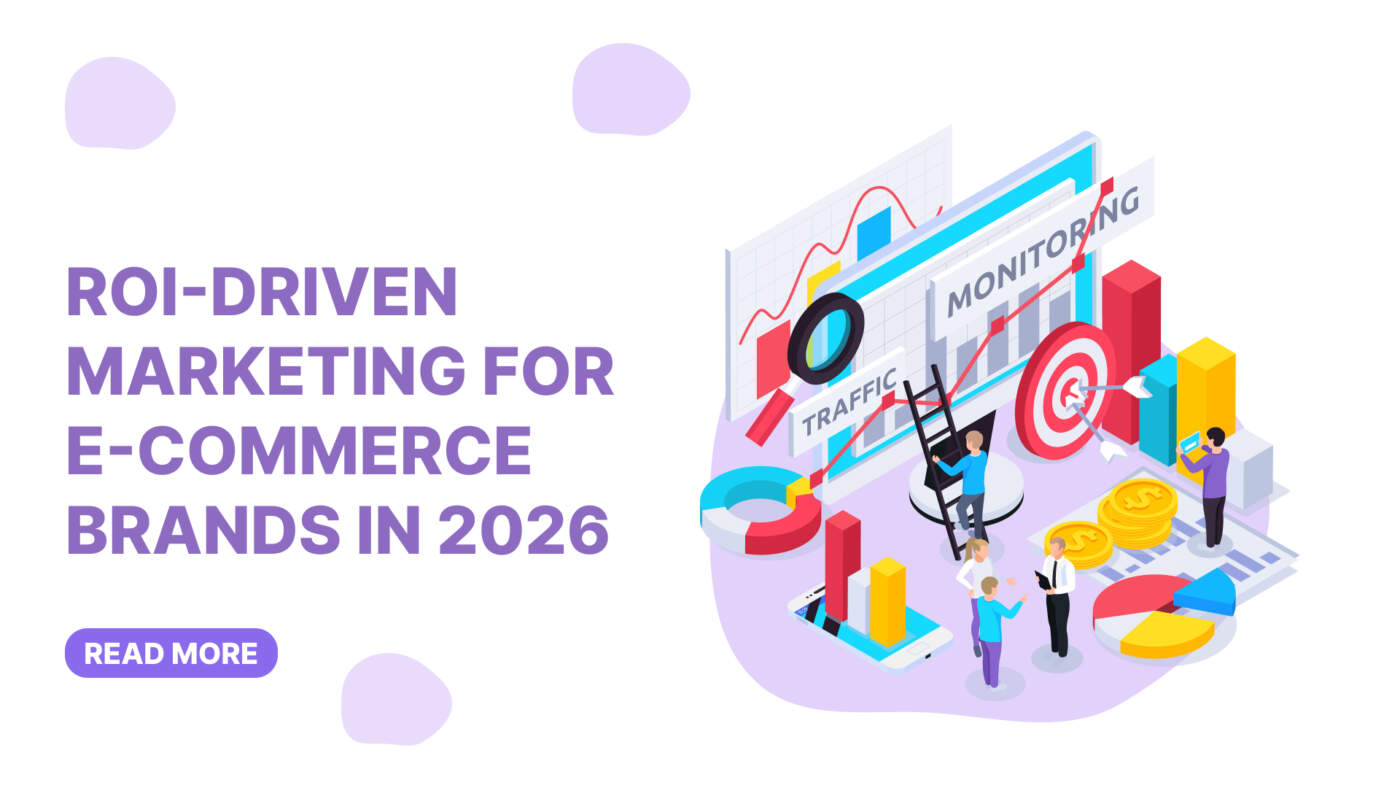

ROI-driven marketing for e-commerce has fundamentally changed how brands scale in 2026.
What worked even a year or two ago—bigger budgets, louder ads, chasing ROAS screenshots—no longer delivers sustainable growth. Customer acquisition costs are higher. Platforms are more automated. Consumers are more selective. And privacy-first tracking means brands operate with imperfect data by default.
In 2026, growth isn’t about spending more.
It’s about knowing exactly what works, why it works, and how far you can push it without breaking profitability.
That’s why ROI-driven marketing for e-commerce is no longer a competitive advantage. It’s the baseline.
At AdSyzygy, this mindset has always guided how we scale brands—but now, the market has caught up.

What ROI-Driven Marketing for E-Commerce Actually Means Today
Let’s clear something up.
ROI-driven marketing for e-commerce in 2026 is not just watching ROAS or celebrating low CPAs. Those metrics matter—but on their own, they’re incomplete and often misleading.
True ROI-driven marketing answers deeper questions:
- Are we driving incremental revenue, or just taking credit for existing demand?
- Are our ads attracting profitable customers, or just low-cost buyers?
- How does acquisition affect lifetime value, retention, and cash flow?
- Can this strategy scale next month—and still work next year?
When ROI becomes the lens for every decision, marketing stops being guesswork.
It becomes a system.
Why Traditional E-Commerce Marketing Strategies Fail in 2026
Many brands struggle in 2026 not because they’re bad at marketing—but because they’re using outdated playbooks in a new environment.
Automation Won’t Save a Broken Strategy
Ad platforms are smarter than ever. But automation only amplifies what you feed it. Weak creative, unclear offers, or fragile funnels don’t get fixed—they get exposed faster.
Attribution Will Never Be Perfect Again
Last-click attribution is comforting, but it’s no longer reality. Brands waiting for perfect data usually scale too late—or not at all.
Customers Don’t Buy From Ads Alone
Ads create interest. Conversions happen across the entire experience: landing pages, product pages, social proof, emails, and post-purchase flows.
In 2026, growth comes from connected systems, not isolated campaigns.
The AdSyzygy Philosophy: ROI-Driven Marketing Systems That Scale
ROI-driven brands don’t obsess over finding one winning ad.
They focus on building revenue engines that perform repeatedly.
Here’s how that philosophy shows up in practice.
1. Start With the Business, Not the Platform
Before touching ads, ROI-driven teams understand:
- Margins
- Break-even CAC
- Average order value
- Customer lifetime value
Marketing doesn’t exist to rescue bad economics. It exists to scale good ones.
2. Build Systems, Not Spikes
A strong month doesn’t equal a strong business.
Sustainable growth comes from systems like:
- Structured creative testing
- Clear offer ladders
- Continuous funnel optimization
- Tight feedback loops between paid media and CRO
This is how brands stop living launch to launch.
3. Use Data With Context
Dashboards don’t grow businesses—decisions do.
ROI-driven marketing for e-commerce works best when performance data connects to inventory planning, cash flow timing, retention, and long-term profitability.
How ROI-Driven Marketing for E-Commerce Scales Brands in 2026
Step 1: Define the Real Break-Even Point
Before scaling spend, successful brands clearly define:
- True break-even CAC
- Contribution margin per order
- Acceptable payback window
When the math is clear, scaling becomes confident—not stressful.
Step 2: Scale Creative Before You Scale Budget
In 2026, creative is the biggest lever.
ROI-driven e-commerce brands:
- Test messaging tied to real customer objections and desires
- Measure how creative impacts AOV and LTV—not just clicks
- Treat creative production as a repeatable system, not a scramble
Scaling spend without scaling creative diversity is how ROI quietly collapses.
Step 3: Optimize for Customer Value, Not Just ROAS
A customer who buys once and disappears isn’t growth.
ROI-driven marketing for e-commerce aligns acquisition with retention:
- Faster payback through post-purchase flows
- Offers designed for customer quality, not just volume
- Lifecycle optimization from first click to repeat purchase
This is where profitability compounds.
Step 4: Expand Channels With Intention
Being everywhere isn’t the goal.
In 2026, smart expansion focuses on channels that:
- Create new demand
- Build trust through storytelling
- Integrate cleanly into existing systems
Omnichannel works when it compounds—not when it distracts.

Future-Proof E-Commerce Growth Beyond 2026
ROI-driven marketing for e-commerce isn’t about squeezing short-term profit.
It’s about resilience.
Future-proof brands:
- Own their customer relationships
- Treat creative as a long-term asset
- Measure performance without relying on perfect attribution
- Run marketing like a profit center, not a cost
This is the core of the AdSyzygy philosophy: measure what matters, build what scales, and let data—not hype—drive growth.
Final Thoughts on ROI-Driven E-Commerce Marketing
In 2026, ROI isn’t just a metric.
It’s the strategy.
The brands that win don’t ask:
“How do we get more traffic?”
They ask:
“How do we turn every dollar of spend into sustainable, repeatable profit?”
That shift in thinking is what separates brands that stall from brands that scale—and it’s exactly how adsyzygy applies ROI-driven marketing for e-commerce to help brands grow with clarity, confidence, and measurable ROI.
Leave a Comment