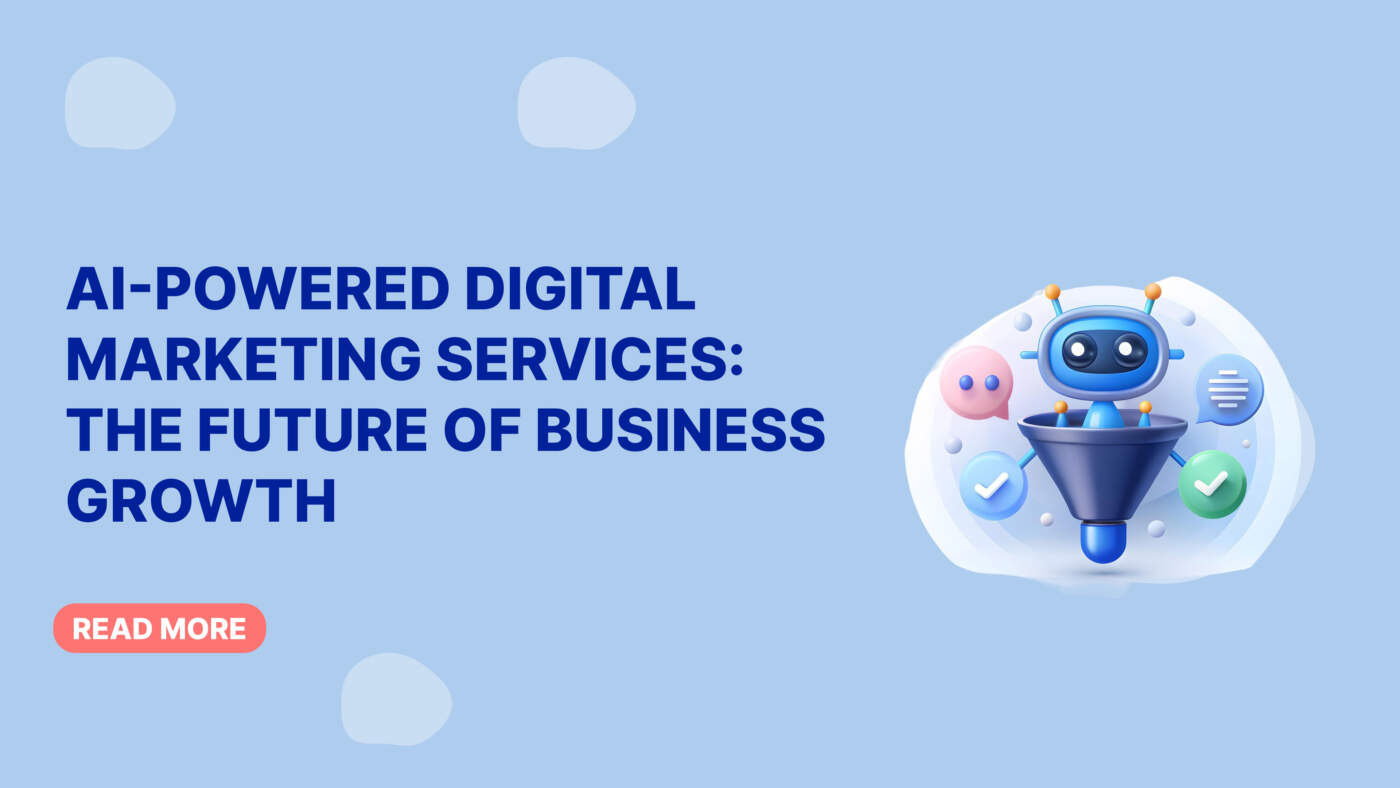

Digital marketing is changing faster than ever. Businesses are no longer relying only on traditional advertising, manual campaign management, or basic audience targeting to reach customers. Today, artificial intelligence is becoming a powerful part of modern marketing strategies, helping businesses understand customers, create better content, optimize campaigns, and make smarter decisions. This shift has given rise to AI-powered digital marketing services, which are quickly becoming an important part of how businesses grow online.
AI is not simply another technology trend. It is changing the way marketers approach everyday tasks and long-term strategies. From analyzing customer behavior to predicting which advertising campaign is likely to perform better, AI can process huge amounts of information in a fraction of the time it would take a human team. When combined with human creativity, strategic thinking, and industry knowledge, AI can help businesses build marketing campaigns that are faster, more personalized, and more effective.
What Are AI-Powered Digital Marketing Services?
AI-powered digital marketing services use artificial intelligence and machine learning technologies to improve different areas of online marketing. Instead of depending entirely on manual research and decision-making, marketers can use AI to identify patterns, automate repetitive tasks, understand audiences, and optimize campaigns based on real-time data.
These services can be applied across SEO, social media marketing, paid advertising, content marketing, email marketing, customer engagement, and analytics. The goal is not to replace marketers but to give them better tools to work smarter.
For example, an AI system can analyze thousands of customer interactions and identify which products are attracting the most attention. It can also help determine what type of content customers prefer, when audiences are most active, and which advertising messages are generating better engagement. Marketers can then use these insights to create more relevant campaigns.
Why AI Is Becoming Important in Digital Marketing
The biggest challenge businesses face today is the amount of digital information available. Customers interact with brands through websites, search engines, social media platforms, emails, advertisements, and online marketplaces. Managing and understanding all these interactions manually can be difficult.
AI helps marketers turn large amounts of data into useful insights. Instead of spending hours reviewing reports, marketers can use AI-powered platforms to identify trends and opportunities much faster. This allows businesses to respond quickly when customer behavior changes.
Another major advantage is personalization. Customers increasingly expect brands to understand their interests and provide relevant experiences. AI can analyze browsing behavior, previous purchases, engagement patterns, and other signals to help businesses deliver more personalized marketing messages.
When customers receive content that actually matches their needs, they are more likely to engage with the brand and eventually become paying customers.
AI-Powered SEO for Better Search Visibility
Search engine optimization remains one of the most important digital marketing strategies, but SEO has become much more complex. Search engines continuously update their algorithms, while businesses compete for visibility across increasingly competitive search results.
AI-powered SEO services can make the optimization process more efficient. AI tools can help marketers identify relevant keywords, analyze competitors, discover content gaps, understand search intent, and monitor website performance.
Instead of simply targeting keywords with high search volume, marketers can use AI to understand what users are actually looking for. This helps businesses create content that answers real customer questions rather than producing content purely for search engines.
AI can also support technical SEO by identifying potential website issues, analyzing page performance, and highlighting areas that may require improvement. However, human expertise remains essential because successful SEO requires strategic judgment, quality content, and an understanding of the business’s target audience.
AI and Content Marketing
Content is still at the heart of digital marketing. Businesses need blog posts, social media content, advertisements, landing pages, emails, videos, product descriptions, and other forms of communication to stay visible online.
AI can make content marketing faster and more organized. It can help marketers generate ideas, research topics, create content outlines, identify audience interests, and adapt messages for different platforms.
The real value comes when AI is combined with human creativity. AI can help with speed and research, while marketers can add personality, brand voice, storytelling, experience, and emotional connection.
Businesses should not publish generic AI-generated content simply because it is quick to produce. Customers can recognize when content feels repetitive or impersonal. The best approach is to use AI as a creative assistant while keeping human oversight at every important stage.
AI-Powered Social Media Marketing
Social media marketing requires constant attention. Brands need to create content, respond to customers, monitor trends, analyze performance, and adjust their strategies regularly.
AI can simplify many of these activities. It can analyze engagement data, identify high-performing content, suggest content ideas, and help marketers understand audience behavior. AI-powered systems can also assist with social listening by identifying discussions and trends surrounding a brand or industry.
For businesses managing multiple social media platforms, AI can save valuable time. Instead of manually analyzing every post, marketers can quickly identify which formats, topics, and messages are producing the strongest results.
However, social media is fundamentally about human connection. AI can support the process, but brands still need authentic communication and genuine interaction with their audience.
Smarter PPC and Google Ads Campaigns
Paid advertising is another area where AI is having a major impact. Businesses want to generate the highest possible return from their advertising budgets, and AI can help optimize campaigns based on performance data.
AI-powered advertising systems can analyze audience behavior, identify high-performing keywords, adjust bids, test different messages, and predict which users are more likely to convert.
This can make PPC campaigns more efficient because decisions can be based on real-time data rather than assumptions. Businesses can also use AI to identify underperforming campaigns and allocate budgets more effectively.
Two major benefits of AI-powered advertising include:
- Better campaign optimization: AI can continuously analyze performance signals and help marketers improve targeting, bidding, and ad delivery.
- Improved audience personalization: Businesses can create more relevant advertisements based on customer interests, behaviors, and intent.
Even with advanced automation, marketers should continue monitoring campaigns. AI works best when it operates within a clear strategy and is guided by human expertise.
Predictive Analytics and Customer Insights
One of the most valuable applications of AI in digital marketing is predictive analytics. Traditional analytics primarily tells businesses what happened in the past. AI-powered predictive analytics can help businesses understand what may happen next.
For example, AI can analyze previous purchases, website activity, customer interactions, and campaign data to identify patterns associated with future purchases. Businesses can use these insights to plan campaigns, improve customer retention, and identify potential opportunities.
Predictive analytics can also help marketers identify customers who may be ready to purchase or customers who may be at risk of leaving. This gives businesses an opportunity to create targeted campaigns before it is too late.
AI Chatbots and Customer Engagement
Customer expectations have changed significantly. People want quick answers, easy communication, and immediate support. AI-powered chatbots can help businesses provide faster responses to common customer questions.
A chatbot can assist customers with product information, frequently asked questions, order-related queries, appointment requests, and basic support. This can improve the overall customer experience while reducing the workload for human support teams.
However, chatbots should not replace human support completely. Complex or sensitive customer issues still require human interaction. The best customer service strategy combines AI automation with human assistance.
The Role of AI in Email Marketing
Email marketing can become much more effective when AI is used correctly. Instead of sending the same email to an entire database, businesses can use AI to segment audiences and personalize communication.
AI can analyze customer behavior to determine which products, topics, or offers may be most relevant to individual users. It can also help marketers identify better sending times and analyze email performance.
Personalized email campaigns can improve engagement because customers receive messages that are more relevant to their interests and previous interactions with the brand.
Benefits of AI-Powered Digital Marketing for Businesses
The biggest benefit of AI-powered marketing is efficiency. Marketing teams can automate repetitive processes and spend more time on strategy, creativity, and customer relationships.
AI can also help businesses make data-driven decisions. Instead of relying purely on assumptions, marketers can use real-time information to understand what is working and what needs improvement.
Another advantage is scalability. A small marketing team can use AI tools to manage tasks that would traditionally require significantly more time and resources. This allows growing businesses to compete more effectively in crowded digital markets.
AI can also improve marketing consistency. Automated reporting, audience segmentation, campaign monitoring, and content workflows can help businesses maintain a structured approach across multiple channels.
AI Does Not Replace Human Marketers
There is a common misconception that AI will completely replace digital marketers. In reality, the strongest marketing strategies are likely to combine AI capabilities with human intelligence.
AI is excellent at processing information, identifying patterns, automating repetitive tasks, and making predictions. Humans are better at understanding emotions, building relationships, developing creative concepts, and making strategic decisions in situations where context matters.
A successful AI-powered marketing strategy therefore needs both sides. Technology can provide speed and insights, while marketers provide creativity, judgment, and brand understanding.
The Future of AI-Powered Digital Marketing
The future of digital marketing will likely become increasingly intelligent and personalized. AI will continue to influence how businesses understand customers, create content, manage advertising campaigns, and measure performance.
As AI technology improves, businesses may be able to predict customer needs more accurately and deliver highly personalized experiences across different digital channels.
Marketing agencies will also need to evolve. Instead of simply offering individual services such as SEO, social media, or PPC, agencies will increasingly combine AI-driven insights with broader performance strategies.
For businesses, this means choosing a digital marketing partner that understands both technology and marketing fundamentals. Having access to AI tools alone is not enough. The real advantage comes from knowing how to use those tools to achieve measurable business objectives.
How Businesses Can Prepare for an AI-Driven Marketing Future
Businesses should begin by identifying where AI can provide genuine value. Not every marketing task needs automation. Companies should focus on areas where AI can save time, improve decision-making, or enhance customer experiences.
They should also invest in quality data. AI systems depend heavily on the information they receive. Clean, accurate, and relevant data can lead to better insights and more useful marketing decisions.
Most importantly, businesses should maintain a human-centered approach. Technology should make customer experiences better, not make brands feel robotic.
Conclusion
AI-powered digital marketing services are becoming an important part of modern business growth. From SEO and content creation to social media, PPC, predictive analytics, email marketing, and customer engagement, AI is helping businesses work faster and make smarter decisions.
The future is not about choosing between AI and human marketers. It is about bringing them together. Businesses that combine intelligent technology with creativity, strategy, and authentic customer communication will be better positioned to compete in the evolving digital landscape.
For businesses looking to embrace this transformation, adsyzygy can be part of the journey toward smarter, more performance-focused digital marketing. By combining modern technology with strategic marketing expertise, businesses can move beyond vanity metrics and focus on meaningful growth, stronger customer relationships, and measurable results.
Leave a Comment