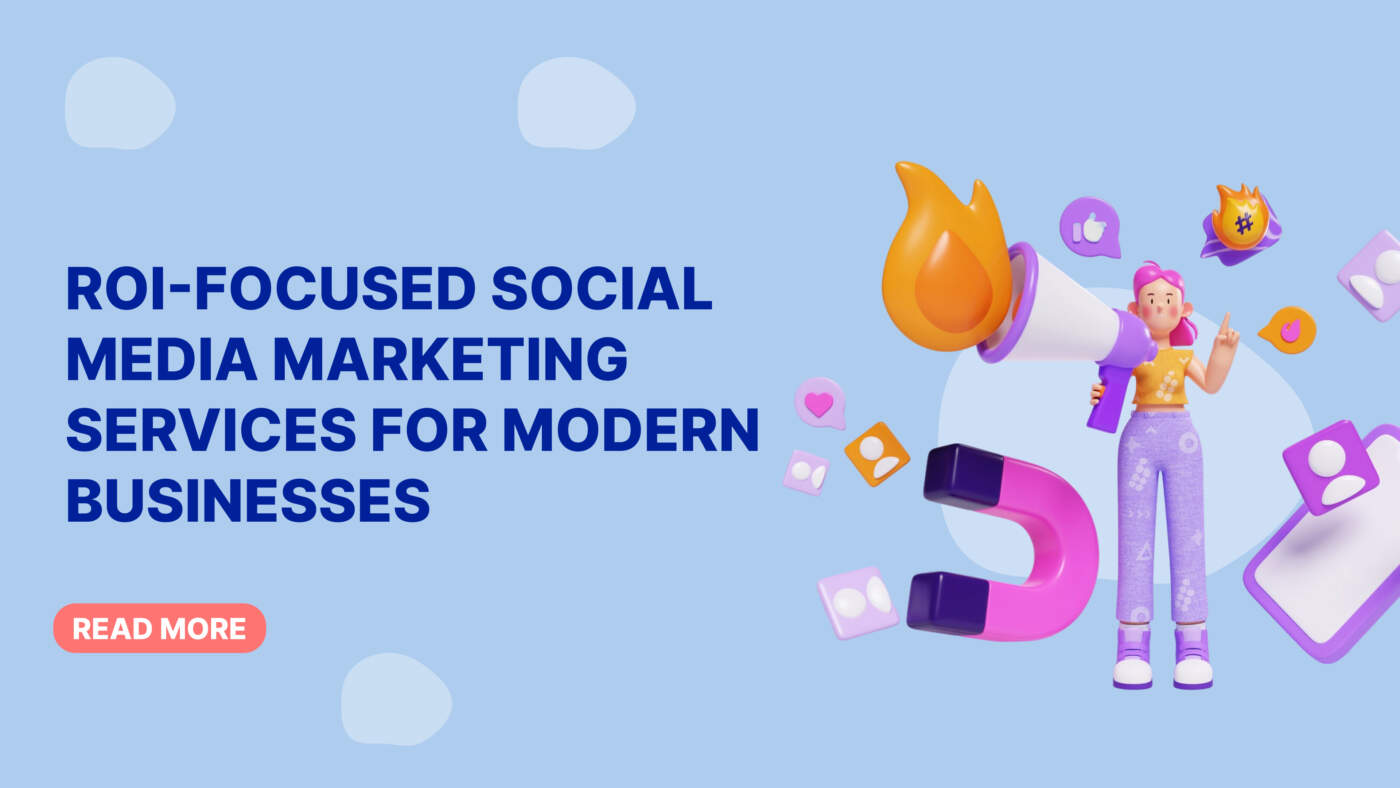

Social media has changed the way modern businesses attract customers, build brands, and generate revenue. Platforms such as Instagram, Facebook, LinkedIn, YouTube, and other social channels are no longer used only for sharing updates or creating awareness. They have become important marketing channels where businesses can connect with potential customers, generate leads, drive website traffic, promote products, and increase sales.
But there is one question businesses are asking more often today: Is social media actually generating a return on investment?
Getting likes, followers, views, and comments can certainly look impressive, but these numbers do not always translate into business growth. A campaign can receive thousands of impressions and still generate very few customers. This is why modern businesses are increasingly looking for ROI-focused social media marketing services that connect social media activities with measurable business outcomes.

An ROI-focused approach does not mean ignoring creativity or engagement. Instead, it combines creative content with strategy, audience targeting, data analysis, paid advertising, conversion optimization, and continuous improvement. The goal is simple: make every marketing effort work harder toward a meaningful business objective.
What Does ROI-Focused Social Media Marketing Mean?
ROI-focused social media marketing is an approach where campaigns are planned and measured based on their contribution to business growth. Instead of focusing only on vanity metrics, businesses look at metrics that indicate whether their social media investment is producing valuable results.
For example, a company running a lead generation campaign may care more about qualified leads and cost per lead than the number of likes on its posts. An e-commerce business may focus on purchases, revenue, conversion rates, and return on ad spend. A service-based company may prioritize enquiries, calls, form submissions, and booked appointments.
This approach starts with a clear business objective. Once the objective is established, the social media strategy, content, advertising, audience targeting, and measurement systems are designed around it.
That makes ROI-focused marketing fundamentally different from simply maintaining an active social media profile. Every major activity has a reason behind it.
Why Businesses Need an ROI-Driven Social Media Strategy
Social media marketing has become increasingly competitive. Customers see countless posts, advertisements, videos, and promotional messages every day. Simply publishing content consistently is no longer enough to guarantee visibility or conversions.
Businesses need to understand what their audiences respond to and what actually contributes to revenue. An ROI-driven strategy helps marketers identify which campaigns, content formats, audiences, and platforms are generating the strongest results.
It also helps businesses make smarter budget decisions. Instead of spending the same amount on every campaign, marketers can shift resources toward campaigns that demonstrate stronger performance.
This does not mean every post must immediately generate a sale. Brand awareness, engagement, and audience building can have long-term value. However, businesses should understand how those activities support the broader customer journey.
Start With Clear Business Goals
A successful social media campaign begins with a clearly defined goal. Without a goal, it becomes difficult to determine whether the campaign is successful.
A business may want to increase online sales, generate qualified leads, promote a new product, grow website traffic, improve brand awareness, or encourage customers to visit a physical location. Each objective requires a different strategy.
For example, an e-commerce brand might use product-focused reels and paid advertisements to drive customers directly to product pages. A professional services company might create educational LinkedIn content and lead generation campaigns to attract potential clients.
Once the goal is clear, marketers can identify the right key performance indicators and build campaigns around them.
Audience Research Makes Marketing More Effective
One of the biggest advantages of social media marketing is the ability to reach specific audiences. However, precise targeting only works when businesses understand who they are trying to reach.
ROI-focused social media marketing begins with audience research. Marketers need to understand customer demographics, interests, online behavior, pain points, purchasing motivations, and common objections.
A business selling premium fashion products, for example, should not necessarily target everyone interested in clothing. A more focused audience based on factors such as buying behavior, interests, location, age group, and purchasing intent may produce better results.
Understanding the audience also improves content. When businesses know what their customers care about, they can create content that feels useful and relevant rather than overly promotional.
Content Should Have a Purpose
Content is one of the most visible parts of social media marketing, but not every piece of content needs to perform the same role.
Some content is designed to introduce the brand. Other content builds trust, educates customers, demonstrates products, answers questions, or encourages purchases.
A strong content strategy usually includes different types of content that work together throughout the customer journey. Educational posts can attract new audiences, testimonials can build credibility, and product demonstrations can help customers make purchasing decisions.
Short-form video has also become an important format for many brands because it provides an opportunity to communicate ideas quickly. However, the goal should not simply be to create videos because they are popular. The content should support the campaign objective and appeal to the intended audience.
Paid Social Media Advertising and ROI
Organic content can help build a strong social media presence, but paid advertising allows businesses to reach targeted audiences at scale.
Platforms such as Instagram and Facebook provide sophisticated advertising options that allow marketers to test different audiences, creatives, offers, and campaign objectives. LinkedIn can be particularly useful for B2B businesses looking to reach professionals and decision-makers.
ROI-focused paid social media marketing involves continuous testing and optimization. Instead of launching one advertisement and leaving it unchanged, marketers can compare multiple creative concepts, headlines, audience groups, and offers.
Campaign performance can then guide future decisions.
For example, if one creative generates significantly more qualified leads at a lower cost than another, the marketing team can allocate more budget toward the stronger performer. This process allows advertising budgets to become increasingly efficient over time.
Conversion Optimization Is Just as Important
Generating clicks is only one part of the marketing process. What happens after someone clicks on your advertisement or social media post can have an even greater impact on ROI.
If a campaign generates thousands of visitors but the landing page is confusing, slow, poorly designed, or lacks a clear call to action, many potential customers may leave without converting.
This is why ROI-focused social media marketing often extends beyond the social platform itself. Landing pages, product pages, enquiry forms, website experiences, and checkout processes can all influence campaign performance.
Marketers should examine the complete customer journey rather than evaluating social media performance in isolation.
Data and Analytics Drive Better Decisions
Data is at the center of ROI-focused marketing. Businesses need accurate information to understand what is working and what needs improvement.
Important metrics may include reach, engagement rate, click-through rate, website traffic, conversion rate, cost per lead, customer acquisition cost, revenue generated, and return on ad spend.
However, the most important metrics depend on the campaign objective.
A brand awareness campaign may focus on reach and impressions, while an e-commerce campaign may focus on purchases and revenue. A lead generation campaign may prioritize qualified leads and cost per acquisition.
The key is to connect metrics to business goals instead of treating every number as equally important.
Two Key Principles of ROI-Focused Social Media Marketing
- Measure business outcomes, not just engagement: Likes, shares, views, and followers can provide useful insights, but leads, sales, revenue, customer acquisition cost, and conversion rates provide a clearer picture of business impact.
- Test, analyze, and optimize continuously: Social media performance can change quickly. Testing different audiences, creatives, offers, and messaging helps businesses identify what works and improve campaign efficiency.
The Role of Social Media Retargeting
Not every customer is ready to purchase the first time they discover a brand. Someone might watch a product video, visit a website, browse products, and leave without taking action.
Retargeting allows businesses to reconnect with people who have already interacted with their brand. These audiences can be valuable because they have already demonstrated some level of interest.
For example, an e-commerce business can show advertisements to people who viewed a product but did not purchase it. A service business may retarget visitors who reached a landing page but did not submit an enquiry.
When used strategically, retargeting can help businesses recover potential customers and improve overall campaign efficiency.
Building Trust Through Social Proof
Customers naturally look for evidence before making purchasing decisions. Social media provides businesses with an opportunity to showcase customer experiences through reviews, testimonials, case studies, user-generated content, and product demonstrations.
Social proof can make marketing messages feel more authentic because potential customers can see evidence of other people’s experiences.
For service businesses especially, testimonials and case studies can help reduce uncertainty. Instead of simply saying that a service is effective, the business can demonstrate how it helped a real customer solve a specific problem.
This type of content can contribute to both engagement and conversion.
Personalization Improves Customer Experience
Modern customers increasingly expect brands to understand their interests. Social media allows businesses to create more relevant experiences by segmenting audiences and adapting messaging.
Different customer groups may respond to different offers, content styles, and communication. A new visitor may need educational content, while someone who has already interacted with the brand may be more interested in a product offer.
Personalization does not necessarily require complicated technology. Even simple audience segmentation can help businesses deliver more relevant messages.
The more relevant the message, the greater the potential for meaningful engagement and conversion.
Choosing the Right Social Media Marketing Partner
Businesses that want measurable social media growth should carefully evaluate the agency or marketing team they choose.
A good social media marketing partner should understand your business objectives before recommending platforms, content types, or advertising budgets. They should also be comfortable discussing performance metrics and explaining how their strategy contributes to business growth.
Look for an agency that provides transparent reporting, understands paid advertising, creates customized strategies, and continuously analyzes campaign performance.
Avoid agencies that focus entirely on follower counts or promise unrealistic overnight results. Sustainable social media growth usually requires research, testing, consistency, and optimization.
Why ROI Matters More Than Vanity Metrics
Vanity metrics are not completely useless. Followers, likes, comments, and views can provide information about audience behavior and content performance. The problem occurs when these metrics become the main measure of marketing success.
Imagine two campaigns. One receives 100,000 views but generates only a few enquiries. Another receives 20,000 views but produces dozens of qualified leads and several customers.
The second campaign may be far more valuable to the business.
This is why modern marketing teams need to look beyond surface-level performance. The real question is not simply, “How many people saw our content?” It is, “What did those people do, and what value did that activity create for the business?”

Long-Term Benefits of ROI-Focused Social Media Marketing
An ROI-focused approach can create benefits that extend beyond individual campaigns. As businesses collect more performance data, they can develop a better understanding of their audiences and improve future campaigns.
Over time, businesses can identify their strongest platforms, most effective content formats, profitable audience segments, and best-performing offers.
This creates a cycle of continuous improvement. Every campaign provides information that can make the next campaign smarter.
Social media can therefore become a long-term growth channel rather than simply another marketing task on a monthly content calendar.
Conclusion
Modern businesses need more than social media activity—they need measurable results. ROI-focused social media marketing services help businesses move away from random posting and vanity metrics toward strategies built around meaningful objectives such as leads, sales, revenue, and customer growth.
From audience research and content creation to paid advertising, retargeting, analytics, and conversion optimization, every part of the strategy should work together. The goal is not simply to generate attention but to turn that attention into measurable business value.
For businesses looking to build a stronger and more performance-driven digital presence, adsyzygy focuses on combining creative social media marketing with data-driven strategies designed around real business outcomes. With the right strategy, consistent optimization, and a clear focus on ROI, social media can become one of the most valuable growth channels for a modern business.
Leave a Comment