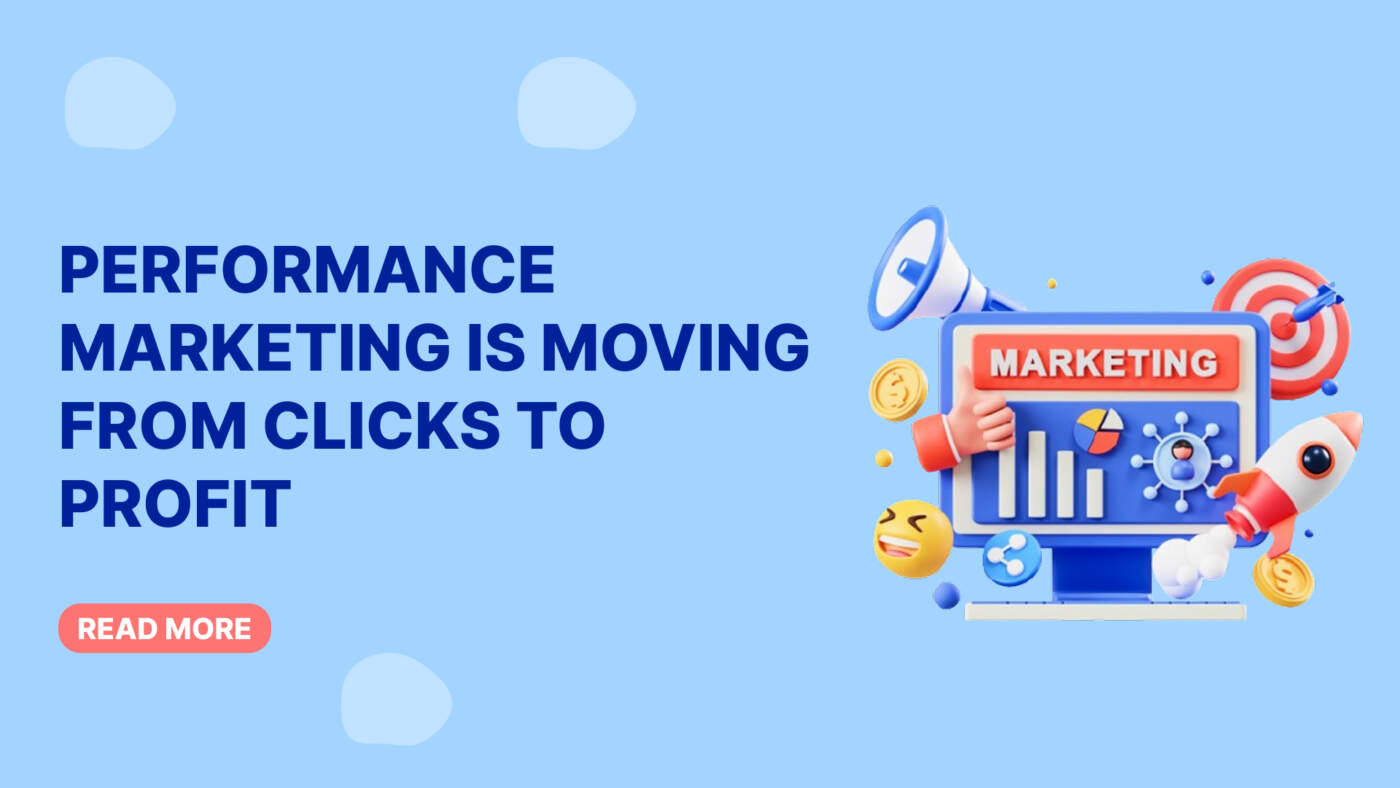

For years, clicks were one of the most important numbers in digital marketing. When an advertisement received thousands of clicks, it was often treated as a sign that the campaign was successful. Marketers looked at click-through rates, website traffic, impressions, and engagement to understand how people were responding to their campaigns. But the digital marketing landscape is changing. Today, businesses are asking a more important question: how much profit is the marketing actually generating?
This is why performance marketing is moving from clicks to profit. Clicks are still useful because they show that an advertisement has attracted attention, but they do not tell the complete story. A campaign can generate thousands of clicks and still fail to produce enough sales or qualified leads. Businesses now want marketing campaigns that contribute directly to revenue and sustainable growth. Instead of simply bringing people to a website, modern performance marketing focuses on turning the right audience into valuable customers.

Why Clicks Are No Longer Enough
A click is only one step in the customer journey. When someone clicks an advertisement, they may visit a website, browse a few pages, leave without buying anything, or return later. In some cases, they may never become a customer at all. This means that focusing heavily on clicks can create a misleading picture of campaign performance.
For example, imagine an online store spends ₹50,000 on digital advertising and receives 20,000 clicks. On the surface, the campaign may look successful because it generated significant traffic. However, if only a small percentage of those visitors make a purchase, the business may not achieve the desired return from its advertising investment. The real question is not how many people clicked the advertisement but how many of those clicks eventually created business value.
This shift is changing the way marketers measure performance. Instead of looking at clicks as the final goal, businesses are paying more attention to conversions, revenue, customer acquisition costs, repeat purchases, and profitability. Clicks can still be an important supporting metric, but they are no longer enough to determine whether a campaign is genuinely successful.
The Rise of Profit-Driven Marketing
Profit-driven marketing focuses on connecting advertising activity with real business results. Rather than optimizing every campaign simply to achieve the lowest possible cost per click, marketers are increasingly looking at whether the campaign attracts customers who are valuable to the business.
For an e-commerce company, this could mean optimizing campaigns around purchases and revenue rather than website visits. For a service-based business, it could mean focusing on qualified leads rather than generating hundreds of enquiries that have little chance of becoming customers. The objective is to make advertising more closely connected to the actual economics of the business.
This approach makes performance marketing more strategic. Marketers need to understand not only advertising platforms but also product margins, sales processes, customer behavior, pricing, retention, and customer lifetime value. When these factors are considered together, businesses can make better decisions about where their advertising budget should go.
From ROAS to Real Profitability
ROAS, or Return on Ad Spend, has traditionally been one of the most popular performance marketing metrics. It measures how much revenue is generated for every rupee spent on advertising. For example, if a company spends ₹10,000 on advertising and generates ₹40,000 in attributed sales, the campaign has a 4X ROAS.
While ROAS is useful, it does not always tell the complete profitability story. Revenue is not the same as profit. A business may have product costs, shipping expenses, platform fees, employee costs, discounts, returns, taxes, and other expenses that reduce the actual profit generated from a sale.
This is why modern performance marketing needs to look beyond ROAS alone. Businesses need to understand how advertising revenue translates into actual profit. A campaign producing a lower ROAS could potentially be more valuable than another campaign with a higher ROAS if the first campaign promotes products with better margins or attracts customers who make repeat purchases.
Profitability therefore needs to become part of the conversation when businesses evaluate their digital advertising campaigns.
Customer Acquisition Cost Matters
Customer Acquisition Cost, commonly known as CAC, is another important metric in profit-focused marketing. CAC measures how much a business spends to acquire a new customer. Understanding this number helps companies determine whether their advertising investment makes financial sense.
For example, if a company spends ₹1,00,000 on marketing and acquires 200 customers, the average customer acquisition cost is ₹500. Whether ₹500 is considered efficient depends on how much value those customers generate. If customers typically purchase products worth several thousand rupees and continue purchasing from the business, the acquisition cost may be sustainable.
However, if customers make only a small purchase and never return, the same acquisition cost could create a profitability problem. This is why CAC should not be viewed in isolation. It needs to be compared with customer value, profit margins, average order value, and retention.
Customer Lifetime Value Is Becoming More Important
Customer Lifetime Value, or CLV, is becoming increasingly important as performance marketing becomes more focused on profitability. Instead of looking only at the value of the first transaction, businesses can consider the total value a customer may generate throughout their relationship with the brand.
Consider two customers who each make a first purchase worth ₹1,000. The first customer never purchases again, while the second customer returns several times over the next year. Although both customers initially generated the same revenue, the second customer may be considerably more valuable to the business.
This changes how marketers think about customer acquisition. A campaign that produces slightly more expensive customers may still be valuable if those customers have stronger retention and higher lifetime value. Performance marketing therefore needs to consider what happens after the initial conversion rather than treating the first purchase as the end of the journey.
AI Is Changing Campaign Optimization
Artificial intelligence is also accelerating the transition toward outcome-focused performance marketing. Advertising platforms are increasingly using machine learning to analyze customer signals, identify potential buyers, adjust bids, distribute budgets, and optimize campaigns toward specific conversion goals.
AI can process enormous amounts of campaign information much faster than a person can manually review every interaction. This allows advertising platforms to make optimization decisions based on patterns across audiences and campaigns.
However, automation does not remove the need for human strategy. AI can only optimize based on the data and objectives provided to it. If conversion tracking is incomplete or the wrong campaign objective is selected, automation may optimize toward a result that does not represent the actual business goal.
For this reason, marketers need to combine AI-powered optimization with accurate data, clear objectives, strong creative strategies, and a solid understanding of profitability.
Creative Still Drives Performance
Moving from clicks to profit does not mean that creative content is becoming less important. In fact, strong creative can become even more valuable because businesses need advertisements that attract the right people rather than simply generating large amounts of traffic.
An effective advertisement needs to capture attention quickly, communicate a clear benefit, create interest, and encourage the viewer to take meaningful action. Businesses are increasingly testing different hooks, visuals, offers, testimonials, product demonstrations, and messaging styles to understand which combinations produce valuable customers.
The goal is no longer simply to create an advertisement that people want to click. The goal is to create advertising that attracts people who have a genuine interest in the product or service and have a higher possibility of becoming customers.
Conversion Optimization Has a Bigger Role
Generating quality traffic is only one part of performance marketing. Businesses also need to make sure their websites and landing pages are designed to convert that traffic effectively.
Imagine two companies spending the same amount on advertising and receiving the same number of visitors. If one website converts 2% of visitors while the other converts 4%, the second business could potentially generate twice as many customers from similar traffic.
Website speed, mobile experience, product presentation, pricing, customer reviews, trust signals, checkout experience, payment options, and calls to action can all influence conversion rates. Improving these areas can help businesses generate more value from the traffic they are already paying for.
This is why conversion optimization is becoming an important part of profit-focused marketing. Instead of continuously spending more money to generate additional visitors, businesses can also look for ways to improve the performance of the traffic they already have.
First-Party Data Is Becoming More Valuable
Another major change in digital marketing is the growing importance of first-party data. First-party data is information that businesses collect directly from their customers and audiences through legitimate interactions with their websites, applications, stores, and marketing channels.
Purchase history, customer preferences, website behavior, email engagement, and subscription information can provide valuable insights into customer behavior. Businesses can use these insights to understand which customers are most valuable and what types of campaigns generate stronger results.
As privacy expectations and tracking technologies continue to evolve, companies that build strong relationships with their own customers can gain a valuable advantage. Instead of depending entirely on external signals, businesses can use their own customer data to improve targeting, personalization, retention, and campaign measurement.
What Profit-Focused Performance Marketing Looks Like
The transition from clicks to profit changes the way marketers evaluate campaigns. Businesses still need to monitor traditional advertising metrics, but these metrics should be connected to larger business outcomes.
Two important areas to monitor are:
- Business outcomes such as revenue, profit contribution, qualified leads, customer acquisition cost, average order value, repeat purchases, and customer lifetime value.
- Campaign efficiency metrics such as ROAS, conversion rate, cost per acquisition, click-through rate, landing-page performance, and creative performance.
The important point is that these metrics should not be analyzed separately. A low cost per click does not automatically mean a campaign is profitable if the traffic does not convert. Similarly, a high ROAS does not necessarily mean a business is making strong profits if product margins and operating costs are high.
The Future of Performance Marketing
The future of performance marketing will increasingly focus on understanding the complete customer journey. Instead of measuring what happens immediately after someone clicks an advertisement, businesses will look at what happens throughout the entire customer lifecycle.
A customer may click an advertisement, visit a website, become a lead, make a purchase, return for another purchase, recommend the brand to someone else, and eventually become a long-term customer. Each stage creates valuable information that can help marketers understand the real impact of their advertising investment.
Better integration between advertising platforms, analytics systems, CRM platforms, e-commerce stores, and sales data will make this possible. Businesses will have a clearer understanding of how their marketing investment contributes to revenue and profitability.
This will also change how marketing teams communicate with business leaders. Instead of reporting only impressions, clicks, and engagement, marketers will increasingly discuss revenue, customer acquisition costs, customer value, and profit contribution.
Why Businesses Need to Change Their Measurement Mindset
The biggest change in performance marketing may not be technological. It may be the way businesses think about marketing itself. Marketing should not simply be viewed as an activity that creates traffic. It should be connected to measurable business outcomes.
When marketing teams understand how their advertising spend affects sales and profitability, they can make more informed decisions. They can identify campaigns that attract valuable customers, reduce wasted advertising spend, improve conversion rates, and allocate budgets more effectively.
This does not mean that every campaign needs to generate immediate profit. Some campaigns may focus on awareness, audience building, or customer education. However, businesses should understand the role each campaign plays and how it contributes to the larger customer journey.
Conclusion
Performance marketing is moving from clicks to profit because businesses are becoming more focused on the actual value generated by their advertising investments. Clicks, impressions, and engagement will continue to be useful indicators, but they are only part of the bigger picture.
Modern performance marketing connects advertising with conversions, revenue, customer acquisition costs, customer lifetime value, retention, and profitability. Businesses that understand these relationships can make more informed decisions and build marketing strategies around sustainable growth rather than vanity metrics.
At adsyzygy, performance marketing is about looking beyond clicks and focusing on measurable business outcomes. By combining data, creative strategy, paid advertising, conversion optimization, and ROI-focused thinking, adsyzygy helps businesses approach digital marketing with a stronger focus on growth and profitability. When marketing is measured by the value it creates, every campaign can become an opportunity to make smarter decisions and build a stronger business.
Leave a Comment